Is Your Medical Blog Hurting Your Rankings? How to Structure Healthcare Blog Content After the 2026 Google Update
After the 2026 Google update, medical blogs need author credentials at the top, direct answers first, proper schema, and medical disclaimers. Here is the updated blog structure that works for healthcare.

Artem S.
CEO, Doctor Rank
The Short Answer
If your medical blog posts were published more than six months ago and have not been updated, there is a strong chance they are hurting your rankings rather than helping them. The 2026 Google core update introduced stricter requirements for healthcare blog content. Blogs on medical websites now need four specific elements to meet Google's standards: an author credentials block at the top identifying who reviewed the content and why they are qualified, a direct answer to the main question within the first 120 words, properly structured heading sections with relevant subheadings, and a medical disclaimer at the bottom. Blogs missing these elements are losing visibility in Google Search and are ineligible for Google Discover.
Why Your Old Blog Content Is Now a Liability
Here is something that catches many practice owners off guard: content that was perfectly fine a year ago may now be actively working against you. This is not because the information is wrong. It is because the format and structure no longer meet Google's updated quality standards for YMYL content.
We manage over 40 medical and legal SEO accounts, and when the 2026 update rolled out, we immediately audited every client website. What we found was consistent across practices: blog posts published even six months earlier were missing critical elements that Google now requires. Author credentials were either buried at the bottom or completely absent. Direct answers were hidden behind three or four paragraphs of background information. Schema markup was incomplete. Medical disclaimers were inconsistent or missing.
The result was predictable. Blog posts that had been steadily driving traffic started losing rankings. Not because the medical information was bad, but because the packaging no longer met Google's expectations for how healthcare content should be presented.
The Updated Blog Structure Google Expects for Medical Content
Based on our analysis of the update documentation and our testing across client accounts, here is the structure that medical blog posts need to follow:
Title: Clear, Question-Based, With an Authority Signal
Your blog title should be the actual question patients are searching for, followed by a qualifier that signals expertise. For example: "How Long Is Liposuction Recovery? Week-by-Week Timeline from a Board-Certified Surgeon." This tells the reader and Google exactly what the content covers and who is behind it. Avoid vague, clever, or clickbait-style titles. If the title does not clearly tell the reader what they will learn, Google will penalize it under the clickbait crackdown.
Author Credentials Block (Immediately After the Title)
This is the single most important structural change from the 2026 update. Right after the title, before any content begins, your blog should display a credentials block. For a medical blog, this looks like: "Medically reviewed by Dr. [Name], Board-Certified [Specialty], [Years]+ years experience, Fellow of [Professional Society], Last updated [Date]."
This block serves two purposes. First, it immediately signals to Google that the content has been reviewed by a qualified medical professional, which is now a requirement for YMYL content to be eligible for Google Discover. Second, it builds trust with the reader before they have read a single word of the actual content. They know a real, credentialed doctor stands behind this information.
For legal blogs, the equivalent would be: "Reviewed by [Attorney Name], Licensed [State] Attorney, [Practice Area], [Years]+ years experience."
Direct Answer in the First 120 Words
Immediately after the author block, the opening paragraph should directly answer the question posed in the title. This is not a summary or a teaser. It is the actual answer. If the blog asks "How much does Invisalign cost?", the first paragraph should state the price range. If the blog asks "What is the recovery time for a tummy tuck?", the first paragraph should state the typical recovery timeline.
After providing the direct answer, include one sentence that gives the reader a reason to continue reading. Something like: "But the total cost depends on several factors that vary by patient. Below, we break down what affects pricing, financing options, and what your initial consultation will cover." This satisfies Google's requirement for a direct answer while keeping the reader engaged for the detailed content that follows.
🔑 Key Insight
"The direct answer should definitely be in the beginning and should definitely be inside the meta description. But it should also give a reason for the reader to continue reading. You provide the answer, then you tell them there is more to discover.", Artem Saribekyan, CEO & Founder, Doctor Rank
Structured Content Sections with H2 and H3 Headings
The body of the blog should be organized into clear sections with descriptive H2 headings and H3 subheadings where appropriate. Each H2 should address a specific subtopic related to the main question. For a blog about liposuction recovery, your H2 sections might cover: the week-by-week recovery timeline, what affects recovery time by body area, when you can return to exercise, and what complications to watch for.
Avoid generic headings like "More Information" or "Additional Details." Every heading should tell the reader exactly what that section covers. This helps both Google and patients navigate the content efficiently.
Provider-Specific Author Bio Block at the End
At the bottom of each blog, include a brief author or reviewer bio that is specific to the topic of that post. This is not a generic, static block that appears the same on every blog. It should be individualized.
For example, if the blog is about Invisalign and the reviewing orthodontist has treated thousands of Invisalign patients, the bio should mention that. If the blog is about colonoscopy and the reviewing gastroenterologist has performed this procedure for 20 years, state that. This topic-specific authority signal at the end reinforces the credentials block at the top and strengthens your topical authority.
Medical Disclaimer
Every medical blog post should end with a clear disclaimer: "This article is for informational purposes only and does not constitute medical advice. Always consult with a board-certified [relevant specialty] for personalized guidance about your specific condition or treatment." The specialty mentioned should match the topic of the blog. A blog about dental implants should reference a dentist or oral surgeon. A blog about skin conditions should reference a dermatologist.
Schema Markup Your Medical Blogs Need
Schema markup is structured code that helps Google understand what your content is and who created it. After the 2026 update, medical blogs should have four types of schema:
Article schema tells Google this is a blog post or article, including the publish date, author, and topic category.
FAQ schema marks up your frequently asked questions section so Google can display them directly in search results.
Person schema for the author connects the blog to a real, credentialed medical professional with verifiable qualifications.
Medical web page schema signals to Google that this is a medical content page that has been reviewed by a qualified healthcare provider.
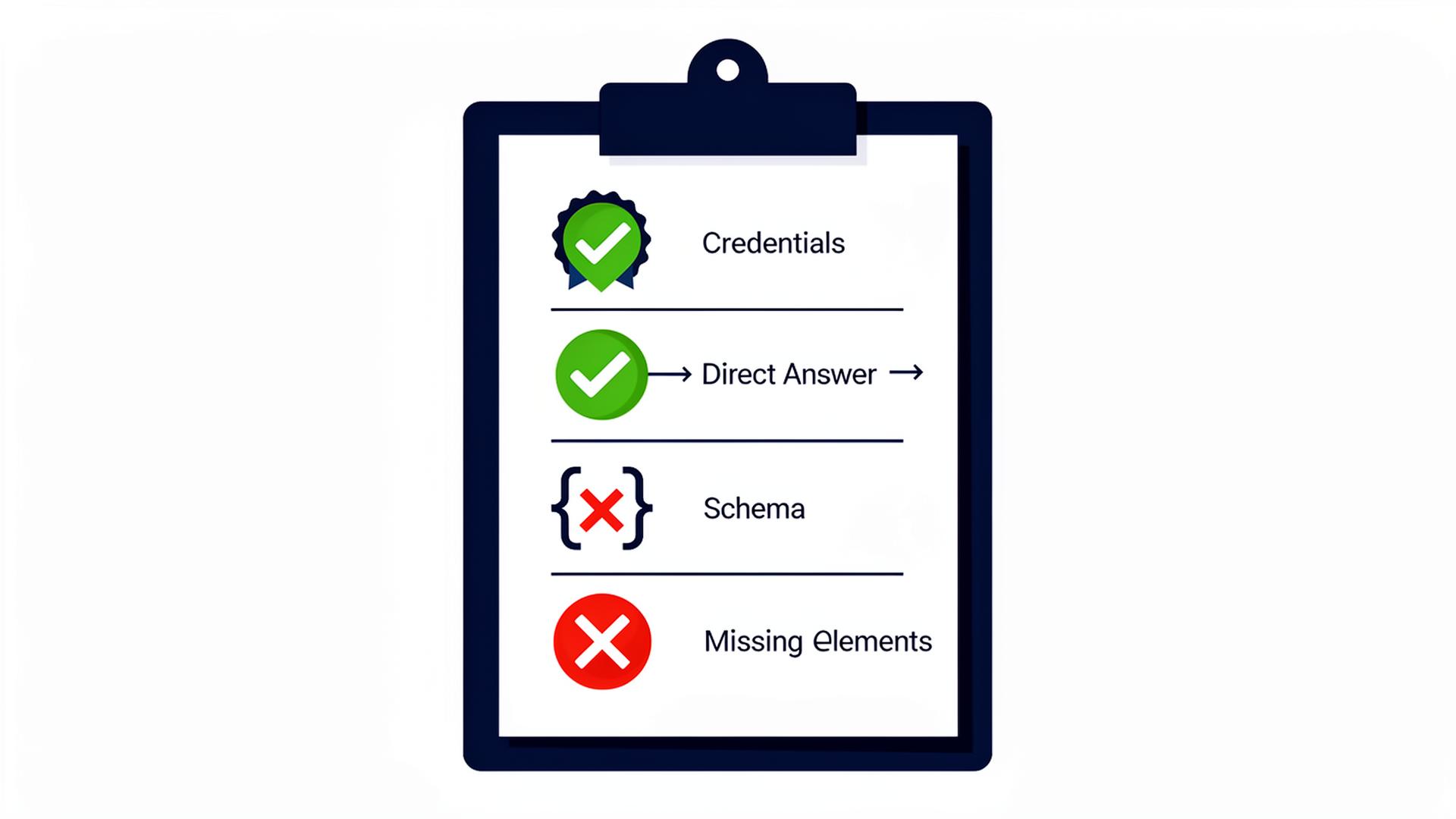
If your blogs currently only have article and FAQ schema, you are missing two critical signals. Adding person schema and medical web page schema is a relatively straightforward technical task, but it requires coordination between your content and your website development team.
How to Audit and Update Your Existing Blog Posts
If you have an existing blog archive, here is the practical process for bringing your content up to standard:
Inventory all of your blog posts. Document the URL, title, publish date, current author attribution, and whether each post has the required elements: credentials block, direct answer, proper headings, medical disclaimer, and complete schema markup.
Prioritize by traffic and keyword importance. Start with the blog posts that drive the most traffic or target your highest-value keywords. These are the ones where outdated formatting is costing you the most.
Update one blog post first and verify the results. Make all the structural changes to a single post, let it get recrawled by Google, and confirm that nothing was broken in the process. Once you have confirmed the approach works, proceed with the rest.
Work through the remaining posts systematically. Depending on how many blog posts your website has, this could take several hours or several days. We recently began updating content across all of our client websites, and many practices had 30 to 50 posts that needed attention. The process is tedious but the ranking impact is real.
What About New Blog Content Going Forward?
Every new blog post you publish should follow this structure from the start. There is no reason to publish content that will need to be retroactively updated. Build the credentials block, direct answer, structured sections, author bio, disclaimer, and schema markup into your standard blog workflow. At Doctor Rank, we updated our content production process across all client accounts to include these elements by default. If you are working with an SEO agency for your medical practice, make sure they are doing the same.
How Doctor Rank Structures Medical Blog Content
We produce blog content for dermatologists, plastic surgeons, dentists, med spas, wellness clinics, and law firms. Every blog we publish follows the updated structure described in this article. Contact us to learn how we can help your practice build a blog that actually drives patient inquiries.
Frequently Asked Questions
How many blog posts should a medical practice publish per week?
Quality matters far more than quantity. One well-structured blog post with proper credentials, direct answers, and complete schema markup will outperform five generic posts. We typically recommend two quality blog posts per week for most medical practices, but the right frequency depends on your specialty and competitive landscape.
Can we use AI to write our medical blog content?
AI can assist with content creation, but it should never be the final voice on medical topics. Google's update specifically targets low-quality AI-generated content that lacks originality and expert review. Any blog published on a medical website should be reviewed by a qualified healthcare provider whose credentials are displayed on the post. The content needs to include real clinical insights.
Do we need to update blogs that are already ranking well?
If a blog post is currently ranking well and driving traffic, approach updates carefully. Add the credentials block and disclaimer if they are missing, but do not make unnecessary changes to content that is performing. Monitor rankings after making structural additions to ensure nothing was negatively affected.
What is Google Discover and why should we care?
Google Discover is a personalized content feed that appears on mobile devices and in the Google app. It recommends articles to users based on their interests and browsing behavior. For medical practices, having blog content appear in Discover can drive significant traffic. However, after the 2026 update, YMYL content must meet strict quality standards, including visible author credentials and clear evidence of expertise, to be eligible for Discover inclusion.
References and Sources
- February 2026 Discover Core Update - Google Search Central Blog
- Creating Helpful, Reliable, People-First Content - Google Search Central Documentation
- Google Search Quality Rater Guidelines - Google (PDF)
- Google Search's Core Updates - Google Search Central Documentation
- E-E-A-T and the Quality Rater Guidelines - Google Search Central Blog
- Google Search Status Dashboard - Google
Published by Doctor Rank. Strategies discussed in this article are based on our direct experience managing SEO for 40+ healthcare and legal practices. Google's algorithms evolve continuously, and what works today may shift with future updates. For a personalized assessment of how these changes affect your practice, contact our team.
Related Services
Written by
Artem S.
Artem is the CEO and founder of Doctor Rank, a digital marketing agency specializing in local SEO and AI search optimization for healthcare providers and legal professionals. Based in New York, Doctor Rank manages SEO for over 20 accounts including personal injury attorneys, family lawyers, criminal defense attorneys, plastic surgeons, dermatologists, and dental practices.
Learn more about our team