Does Website Design Actually Matter for AI Search?
What We See Managing Medical Practices and Law Firms
AI search does not reward pretty websites. It rewards clear ones. We manage medical practices that outrank prettier competitors in AI Overviews. Here is what actually matters.

Artem Saribekyan
CEO, Doctor Rank

The Short Answer
AI search does not reward pretty websites. It rewards clear ones.
We manage medical practice and law firm websites that rank in Google AI Overviews and get cited by ChatGPT despite having simpler designs than competitors ranking below them.
What matters: content structure, information hierarchy, visible trust signals, proper schema markup, and FAQ pages that answer long-tail questions.
What does not matter: fancy animations, trendy layouts, or visual polish.
"Should I Redesign My Website to Rank in AI Search?"
I hear this question constantly from doctors and attorneys. They see competitors with sleek, modern websites and assume that is why they are losing visibility.
They are usually wrong.
My name is Artem, CEO and founder of Doctor Rank. We manage SEO and AI search optimization for medical practices and personal injury law firms. I have seen firsthand what actually moves the needle in AI search results.
The answer might surprise you: design matters far less than you think.
What People Get Wrong About Website Design and AI Search
When doctors and lawyers hear about AI search, they assume:
- AI judges how modern their site looks
- AI prefers fancy layouts and animations
- AI rewards trendy UI and slick visuals
That is false.
AI does not care if your medical practice website looks "cool." It does not care if your law firm site has parallax scrolling or animated hero sections.
🔑 Key Insight
AI cares if it can understand, extract, and trust what you are saying. That is a completely different standard.

What AI Actually Looks At On Your Website
AI systems like Google AI Overviews, ChatGPT, and Perplexity do not browse your website like a human patient or client would. They analyze structure, clarity, and signals.
Content Structure
AI needs to quickly answer three questions about every page:
- What is this page about?
- Who is it for?
- Where is the answer?
Good structure helps by using clear headings (H1, H2, H3), short scannable sections, and obvious question-to-answer flow.
For a plastic surgeon's rhinoplasty page, this means: clear heading stating the procedure, sections covering candidacy, technique, recovery, costs, and credentials. Each section answers what a patient actually wants to know.
For a personal injury attorney's car accident page, this means: clear statement of what you handle, sections covering the legal process, timeline, what to do after an accident, and how contingency fees work.
Bad structure hides answers inside walls of text. AI cannot extract clear answers from that. Neither can patients or clients.
Information Hierarchy
AI favors pages where:
- Important information appears early
- Supporting details come after
- Nothing critical is buried or scattered
This is UX (user experience) at work. A clean layout makes intent obvious. A messy layout creates uncertainty. AI avoids uncertainty because it cannot confidently extract and cite information it is unsure about.
For healthcare and legal websites, this means putting the direct answer at the top of every service page, then supporting it with details below. Not the other way around.
User Behavior Signals
Here is the uncomfortable part most web designers ignore. Google still watches:
- Bounce rate (how quickly visitors leave)
- Time on page
- Engagement
- Pogo-sticking (clicking back to search results immediately)
Bad UX causes users to leave fast. That sends a message to Google: this page is not helpful. AI systems inherit that trust layer.
So no, AI is not reading your CSS or judging your color scheme. But UX affects the behavioral signals AI depends on.
Trust Signals
UX is how you prove authority without saying it. Things AI looks for:
- Clear authorship (who wrote this content)
- Easy-to-find credentials (board certifications, bar admissions)
- Transparent business information
- Logical navigation
Messy UX signals "this might be low quality." Clean UX signals "this looks maintained and intentional." AI is conservative. It avoids risk. For YMYL websites like medical practices and law firms, this matters even more.
What Does NOT Help You Rank in AI Search
Let me be very clear. These things do nothing for AI visibility by themselves:
Design Mistakes That Actually Hurt AI Visibility
Some design choices actively work against you in AI search. Here are the ones I see constantly on medical and legal websites:
Foldable Q&A Sections (Accordions)
Many web designers love accordion-style FAQ sections. Click a question, the answer expands. Looks clean. Saves space.
Problem: AI cannot reliably extract content hidden behind JavaScript interactions. When your FAQ answers are collapsed by default, AI may not see them.
✅ Fix:
Display FAQ content openly. If you must use accordions for design reasons, make sure the content is visible in the HTML source. Better yet, skip accordions entirely for important Q&A content.
Reviews Hidden in Footer or Buried Pages
Reviews are one of the strongest trust signals for YMYL businesses. Google knows this. AI systems know this.
Yet I see medical practices and law firms hiding their reviews. A tiny link in the footer. A testimonials page that takes three clicks to reach. No reviews visible on service pages.
✅ Fix:
Put reviews in your main navigation. Not hidden under "About Us." A dedicated "Reviews" or "Patient Reviews" link in the primary menu. Make it obvious you have social proof.
Missing Schema Markup
Schema markup is code that tells search engines exactly what your content means. It is not visible to visitors, but AI systems read it.
For medical practices, this includes: LocalBusiness schema, Physician or MedicalBusiness schema, FAQPage schema, and Review schema.
For law firms: LegalService or Attorney schema, LocalBusiness schema, FAQPage schema, Review schema.
✅ Fix:
Implement proper schema markup on every page. Test it with Google's Rich Results Test tool. If your web developer does not know how to do this, that is a red flag.
Real-World Proof: What We See Across Our Client Sites
Here is something that does not get talked about enough.
At Doctor Rank, we manage multiple medical practice and law firm websites that show up in Google AI Overviews and are referenced in ChatGPT-style answers. Some of these sites have objectively worse design than competitors ranking below them.
In several cases:
- Our client's site looks older
- The layout is simpler
- The design is less polished than competitors ranking below them
Yet our clients are the ones AI pulls answers from.
What These Sites Have in Common
Despite weaker visuals, the sites that perform well in AI search consistently share:
- Clear service-focused pages that answer real patient or client questions
- Direct answers to the questions people ask
- Strong local signals (optimized Google Business Profile, reviews, citations)
- Content written from real expertise
- Straightforward structure AI can easily parse
- Proper schema markup
Meanwhile, many "better-looking" competitor sites suffer from:
- Overdesigned layouts that bury answers
- Long, vague copy written to sound impressive
- Poor information hierarchy
- Style over substance
- FAQ content hidden in accordions
AI does not reward that.
Bonus Tip: Mine Your Search Console for AI Opportunities
Here is something most medical practices and law firms never think about. Go into Google Search Console. Look at your search queries. Filter for queries that are 8 words or longer.
These long-tail queries often indicate AI-driven searches. People are asking Google questions in natural language, and Google is using AI to answer them.
Example queries for a plastic surgeon:
- • "how long does swelling last after rhinoplasty surgery"
- • "what is the difference between liposuction and tummy tuck"
- • "best age to get a facelift for natural results"
Example queries for a personal injury attorney:
- • "how long do I have to file a car accident claim in Florida"
- • "what happens if the other driver has no insurance"
- • "can I still sue if I was partially at fault for accident"
What to do with these queries:
- 1. Create a dedicated FAQ page if you do not have one
- 2. Add these exact questions to the relevant service page FAQ section
- 3. Answer them directly and clearly
- 4. Add FAQPage schema markup to help AI recognize the Q&A format
You are not guessing what AI searches look like. You are seeing them in your own data.
The Real Hierarchy: What Actually Matters for AI Search
Here is the order that actually works:
Real expertise
Written by someone who actually does this work
Clear answers
Stated up front
Strong structure
Headings, hierarchy, schema
Clean UX
Easy to navigate, nothing hidden
Visual polish
Last priority
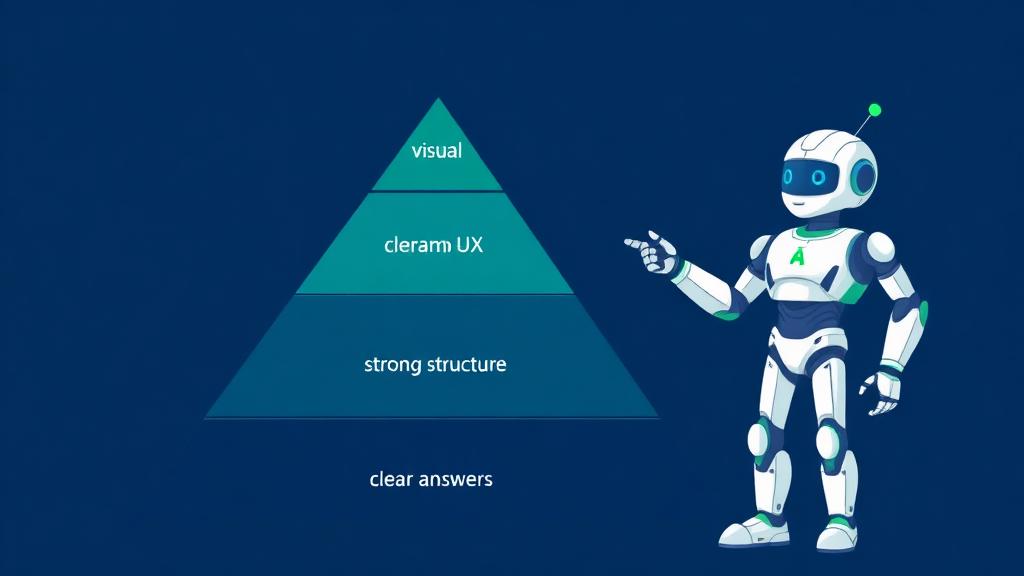
If you reverse that order, AI will not save you.
The Correct Way to Think About Website Design for AI Search
A beautiful website with vague content, hidden answers, and no schema will lose to an ugly website with clear answers, proper structure, and demonstrated expertise.
We see it happen constantly.
"I need better design so AI will like my site."
"I need design that removes friction between my expertise and AI's ability to trust it."
That is the real relationship.
🔑 Key Insight
Design is not the signal. Design supports the signals.
Good design does not make content authoritative. Bad design makes authority harder to recognize.
"AI does not reward the best-looking site. It rewards the clearest one."
"Design is not the signal. Design supports the signals."
Final Verdict
- You do not need a fancy website to rank in AI search
- You do need a website that is easy to understand
- AI rewards clarity
- Bad UX hides your authority
- Schema markup is required
- Accordion FAQs hurt you. Open content helps you.
- Put reviews in your main navigation
- Mine Search Console for 8+ word queries and answer them
Frequently Asked Questions
Does website design affect AI search rankings?
Not directly. AI does not judge how modern or pretty your site looks. It evaluates structure, clarity, and trust signals. Good design can support these factors but cannot replace them. A simple, clear website will outrank a beautiful but confusing one.
Are accordion FAQ sections bad for SEO?
For AI search, yes. Content hidden behind JavaScript interactions may not be reliably extracted by AI systems. Open, visible FAQ content is easier for AI to read, understand, and cite. If you use accordions, make sure the content sits in the HTML source.
What is schema markup and why does it matter for AI?
Schema markup is code added to your website that tells search engines exactly what your content means. For medical practices and law firms, this includes LocalBusiness schema, FAQPage schema, and Review schema. AI systems read this code to understand and trust your content.
How do I find AI search queries in Google Search Console?
Go to Search Console, click Performance, then filter queries by length. Look for queries with 8 or more words. These long-tail, natural language queries often come from AI-assisted searches. Answer these questions directly on your FAQ page or relevant service pages.
Should I put reviews in my main navigation?
Yes. Reviews are a strong trust signal for YMYL (Your Money Your Life) businesses like medical practices and law firms. Hiding them in your footer or a buried page wastes their value. A visible Reviews link in your main menu signals transparency and builds trust with both humans and AI.
What matters more for AI search: design or content?
Content. Specifically, clear answers to real questions, written by someone with genuine expertise. Design supports content by making it easy to find and understand. But no amount of visual polish will help vague, generic, or poorly structured content rank in AI search.
Is Your Website Holding You Back in AI Search?
If you are a medical practice or law firm wondering why competitors are showing up in AI results while you are invisible, the problem is probably not your design. It is your structure, your content, or your missing signals.
At Doctor Rank, we help healthcare providers and attorneys get found where patients and clients are actually searching. That includes Google, AI Overviews, ChatGPT, and Perplexity.
We have one rule: one client per specialty per city. If we already work with a practice in your specialty in your market, we cannot take you.
Book a free consultation to see if your market is available. We will look at your current setup and tell you exactly what is helping and what is hurting your AI visibility.
Written by
Artem Saribekyan
Artem is the CEO and founder of Doctor Rank, a digital marketing agency specializing in local SEO and AI search optimization for healthcare providers and legal professionals. Based in New York, Doctor Rank manages SEO for over 20 accounts including personal injury attorneys, family lawyers, criminal defense attorneys, plastic surgeons, dermatologists, and dental practices.
Learn more about our team