Does Your Doctor Bio Page Help or Hurt Your Rankings? What Google Expects from Provider Profiles in 2026
Your doctor bio page directly affects your search rankings. Google now uses E-E-A-T to evaluate healthcare websites, and thin provider profiles cost you visibility. Learn what top-ranking bios include.

Artem Saribekyan
CEO, Doctor Rank

The Short Answer
Yes, your doctor bio page directly affects your search rankings. Google now uses what is called E-E-A-T, which stands for Experience, Expertise, Authoritativeness, and Trustworthiness, to evaluate healthcare websites. Your provider's about page is one of the strongest signals Google looks at when deciding whether your website deserves to rank for medical search terms. A thin bio that only lists a degree and board certification is no longer enough. Google wants to see detailed credentials, achievements, professional affiliations, publications, teaching roles, and real evidence that this doctor is a recognized authority in their specific field. Even more importantly, Google now evaluates expertise topic by topic across your website. That means if you have a practice with multiple doctors, Google will assess whether each doctor is actually qualified to speak on each specific procedure. Getting this wrong can cost you rankings on your most important pages.
What Is E-E-A-T and Why Does It Matter for Doctor Bios?
E-E-A-T stands for Experience, Expertise, Authoritativeness, and Trustworthiness. It is not a single ranking factor you can toggle on or off. It is a framework Google uses to evaluate the overall quality and reliability of a website, especially for YMYL content. YMYL stands for Your Money or Your Life, and it includes any content related to health, medical procedures, legal matters, and financial decisions. Your doctor bio page is where you prove all of this. It is not a formality or an afterthought. It is one of the most important pages on your entire medical website. If Google cannot find strong evidence of your providers' expertise on your about pages, it has less reason to trust the medical content on the rest of your site.
What a Weak Doctor Bio Looks Like (And Why Google Ignores It)
We recently audited the provider profiles across every client website we manage. What we found was consistent: most doctor bios follow the same generic template. They list the doctor's name, their medical degree, their board certification, maybe the year they graduated, and a few bullet points about professional memberships. That is it.
Here is the problem. This tells Google almost nothing. A medical degree and board certification are baseline qualifications. Every doctor on the first page of Google has those. Listing them without context is like putting on a resume that you graduated high school. It is expected. It does not differentiate you from anyone else.
The specific pattern we kept seeing across client websites was: a short philosophy statement, credentials listed at a glance, a brief two to three paragraph biography, awards mentioned without detail, and links to professional profiles. This format reads like an AI-generated summary. It is structured, clean, and completely forgettable.
🔑 Key Insight
"We analyzed the top-ranking result for 'best plastic surgeon NYC.' His credibility was through the roof. Widely published, over 25 articles and book chapters, teaching residents, consulting for the NYPD for 25 years. How can you compete with someone like that if your bio just lists your medical school and graduation year?" — Artem Saribekyan, CEO & Founder, Doctor Rank
What a Strong Doctor Bio Looks Like (With a Real Example)
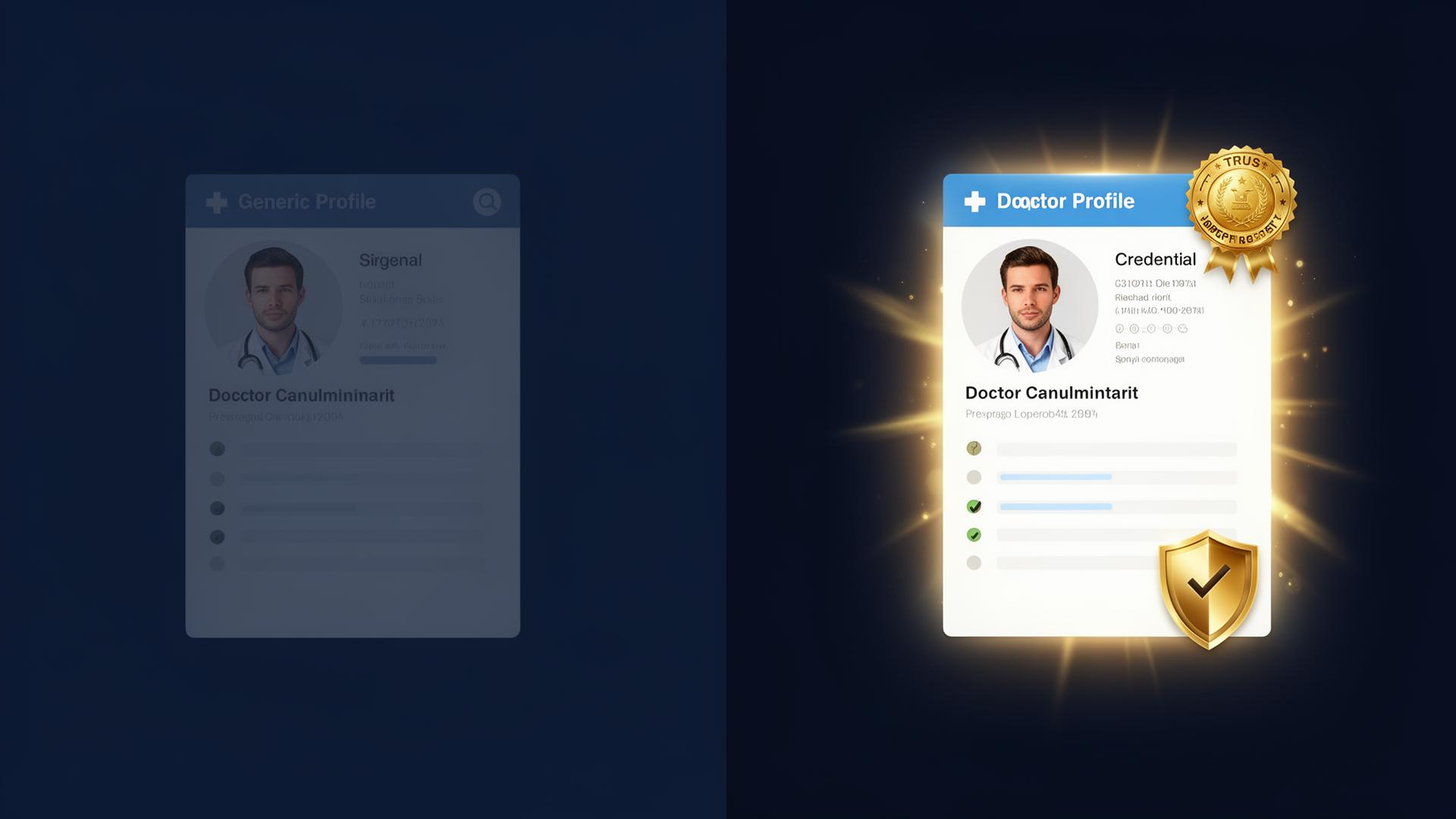
We studied the provider profiles of the top-ranking medical practices across some of the most competitive keywords in our market. The practices that consistently hold the top positions have something in common: their doctor bios read like proof of authority.
Here is what the best profiles include that most practices miss:
Specific achievements beyond degrees
Instead of just saying "graduated from Columbia Medical School," the top profiles mention class rank, honors, or specific academic distinctions. "Graduated with honors" is better than nothing, but "ranked third in their class" or "received the Dean's Award for Clinical Excellence" is what actually moves the needle.
Teaching and leadership roles
If the doctor has taught residents, served as a clinical professor, or held a leadership position at a hospital or professional society, this should be prominently featured. Google interprets these as strong authority signals. When a doctor is teaching other doctors, that is about as strong an expertise signal as you can send.
Publications and Research
Authored or co-authored medical journal articles, book chapters, or research studies carry significant weight. One practice we analyzed listed that their lead surgeon had authored over 25 articles and book chapters. That level of documented expertise is extremely difficult for competitors to match.
Industry Recognition with Context
Being listed in "Top Doctors" or recognized by peer-reviewed organizations means more when you explain what these recognitions are and how they are earned. Instead of just listing the award name, explain that it represents a peer-reviewed selection process where other physicians nominate the best in their specialty.
Unique Professional Contributions
Participation in FDA studies, development of new techniques, consulting roles for organizations, or board positions in professional societies all signal authority that cannot be faked or easily replicated.
Why Google Now Evaluates Expertise Topic by Topic
This is a change that many practices are not aware of, and it has real consequences. Google no longer evaluates your website's expertise as a blanket assessment. It now looks at expertise on a topic-by-topic basis.
Here is what that means in practice. Suppose you run a plastic surgery practice with two doctors. One is a board-certified plastic surgeon who specializes in body procedures like liposuction, tummy tucks, and breast augmentation. The other is a board-certified head and neck surgeon who focuses on facial procedures like rhinoplasty and facelifts. Now, Google evaluates whether the specific doctor associated with each page is qualified to speak on that specific topic. If your head and neck surgeon is the one answering questions on your liposuction page, Google can identify that this doctor's board certification does not cover body procedures. The E-E-A-T signal for that page is weakened because the person presented as the authority is not actually board-certified in that specific area.
We discovered this issue during a recent client audit. A multi-provider practice had one doctor listed as the expert across all procedure pages, including procedures outside of that doctor's board certification. The solution was straightforward: match each doctor to the procedures they are specifically certified for. The facial specialist stays on facial procedure pages. The board-certified plastic surgeon gets associated with body procedure pages.
We cover the broader implications of this shift in our article about how the 2026 Google core update affects medical websites.
How to Handle Multi-Provider Practices
Identify each provider's specific board certifications and areas of expertise. This sounds obvious, but many practices default to featuring the practice owner across every page, even when another provider is more qualified for a specific topic.
Associate each provider with the service pages and blog posts that match their expertise. Your board-certified dermatologist should be the authority on skin-related content. Your fellowship-trained Mohs surgeon should be associated with skin cancer pages. This level of specificity is what Google now rewards.
How to Rewrite Your Doctor Bio for Better Rankings
Start with a compelling professional summary
Not a generic intro like "Dr. Smith is a board-certified dermatologist." Instead, lead with what makes them notable: years of experience, the number of procedures performed, specific areas of focus, or a defining professional achievement.
Detail their education with specifics
Include where they trained, any honors or distinctions, and residency or fellowship details. If they trained at a top-ranked program, say so.
List board certifications with context
Name the certification, then explain what it means. "Board-certified by the American Board of Plastic Surgery" carries more weight when followed by "which requires completing an accredited residency, passing comprehensive written and oral examinations, and maintaining continued education in the specialty."
Highlight publications, research, and teaching
If the doctor has published in medical journals, participated in clinical studies, or taught at a medical school, these are among the strongest authority signals available.
Include professional society memberships and leadership roles
Membership in the American College of Surgeons is good. Being a fellow or holding a board position is better. Explain the distinction.
Add patient-facing context
Include information about their approach to patient care and what patients can expect. Linking to your reputation management and review pages can further reinforce social proof.
How Your Doctor Bio Affects AI Search Recommendations
AI search platforms like Google AI Overviews, ChatGPT, Perplexity, and other AI agents pull information from your website to decide whether to recommend your practice. A strong doctor bio page gives AI platforms the structured information they need to confidently recommend your practice. A thin bio with just a name and degree gives them nothing to work with. We explain this dynamic in detail in our AI search optimization guide.
How Doctor Rank Helps Practices Build Stronger Provider Profiles
At Doctor Rank, we audit and rebuild provider profiles as part of our SEO services for doctors. We do this for plastic surgeons, dermatologists, dentists, med spas, and wellness clinics. Reach out for a free assessment.
Frequently Asked Questions
How long should a doctor bio page be?
There is no magic word count, but the top-ranking provider profiles we have analyzed typically run between 500 and 1,000 words. The length should be driven by the substance available.
Should every provider on our website have their own bio page?
Yes. Every provider who is associated with service pages or blog content on your website should have a dedicated, detailed bio page. This page should be linked from any content they are credited on.
Does the doctor bio need schema markup?
Yes. Your provider pages should have person schema markup that includes the doctor's name, credentials, medical specialty, affiliated organizations, and a link to their profile page. Your blog posts that reference this doctor should also include person schema.
What if our doctor does not have publications or teaching experience?
Focus on what they do have: years of experience, number of procedures performed, patient outcomes, community involvement, professional memberships, continuing education, and specialized training. Even details like "has performed over 5,000 Invisalign treatments" add substance that a generic bio lacks.
References and Sources
- Creating Helpful, Reliable, People-First Content (E-E-A-T) - Google Search Central Documentation
- Google Search Quality Rater Guidelines - Google (PDF)
- E-E-A-T and the Quality Rater Guidelines - Google Search Central Blog
- February 2026 Discover Core Update - Topic-by-Topic Expertise - Google Search Central Blog
- Google Search's Core Updates - Google Search Central Documentation
Published by Doctor Rank. Strategies discussed in this article are based on our direct experience managing SEO for 40+ healthcare and legal practices. Google's algorithms evolve continuously, and what works today may shift with future updates. For a personalized assessment of how these changes affect your practice, contact our team.
Written by
Artem Saribekyan
Artem is the CEO and founder of Doctor Rank, a digital marketing agency specializing in local SEO and AI search optimization for healthcare providers and legal professionals. Based in New York, Doctor Rank manages SEO for over 20 accounts including personal injury attorneys, family lawyers, criminal defense attorneys, plastic surgeons, dermatologists, and dental practices.
Learn more about our team