Is Your Attorney Bio Page Costing You Clients and Rankings? What Google Expects from Lawyer Profiles
Your attorney bio page directly affects whether potential clients contact you and whether Google ranks your firm. Most law firm bios are too thin to send authority signals. Here is what to fix.

Artem Saribekyan
CEO, Doctor Rank
The Short Answer
Yes, your attorney bio page is likely costing you both clients and rankings if it follows the standard template most law firms use. Google now evaluates legal websites through the E-E-A-T framework (Experience, Expertise, Authoritativeness, Trustworthiness), and your attorney bio is one of the strongest signals it looks at. A thin bio that lists your law school, bar admission, and a few practice areas tells Google almost nothing that differentiates you from thousands of other attorneys. Meanwhile, potential clients who land on your bio are making a decision about whether to call you, and a generic profile does not give them a reason to pick up the phone. The fix requires building a comprehensive profile that demonstrates documented authority in your specific practice areas.
Why Attorney Bios Matter More Than Ever for Law Firm SEO
Law firm websites fall under Google's YMYL (Your Money or Your Life) classification. This means Google applies stricter quality standards to your content because the information on your website could directly affect someone's legal rights, finances, or safety. Under this standard, Google looks past whether your content is well-written. It evaluates whether the person behind the content is genuinely qualified.
Your attorney bio page is where Google looks for that proof. It connects the content on your practice area pages and blog posts to a real, identifiable legal professional with verifiable credentials. Without a strong bio page, the rest of your website's authority is weakened because there is no credible foundation to support it.
This is the same dynamic we see with medical websites, where doctor bios directly impact rankings for procedure pages. We covered the medical side in detail in our article on doctor bio pages and rankings. The principle for law firms is identical: the strength of your provider profile determines the ceiling of your content's ranking potential.
What a Weak Attorney Bio Looks Like
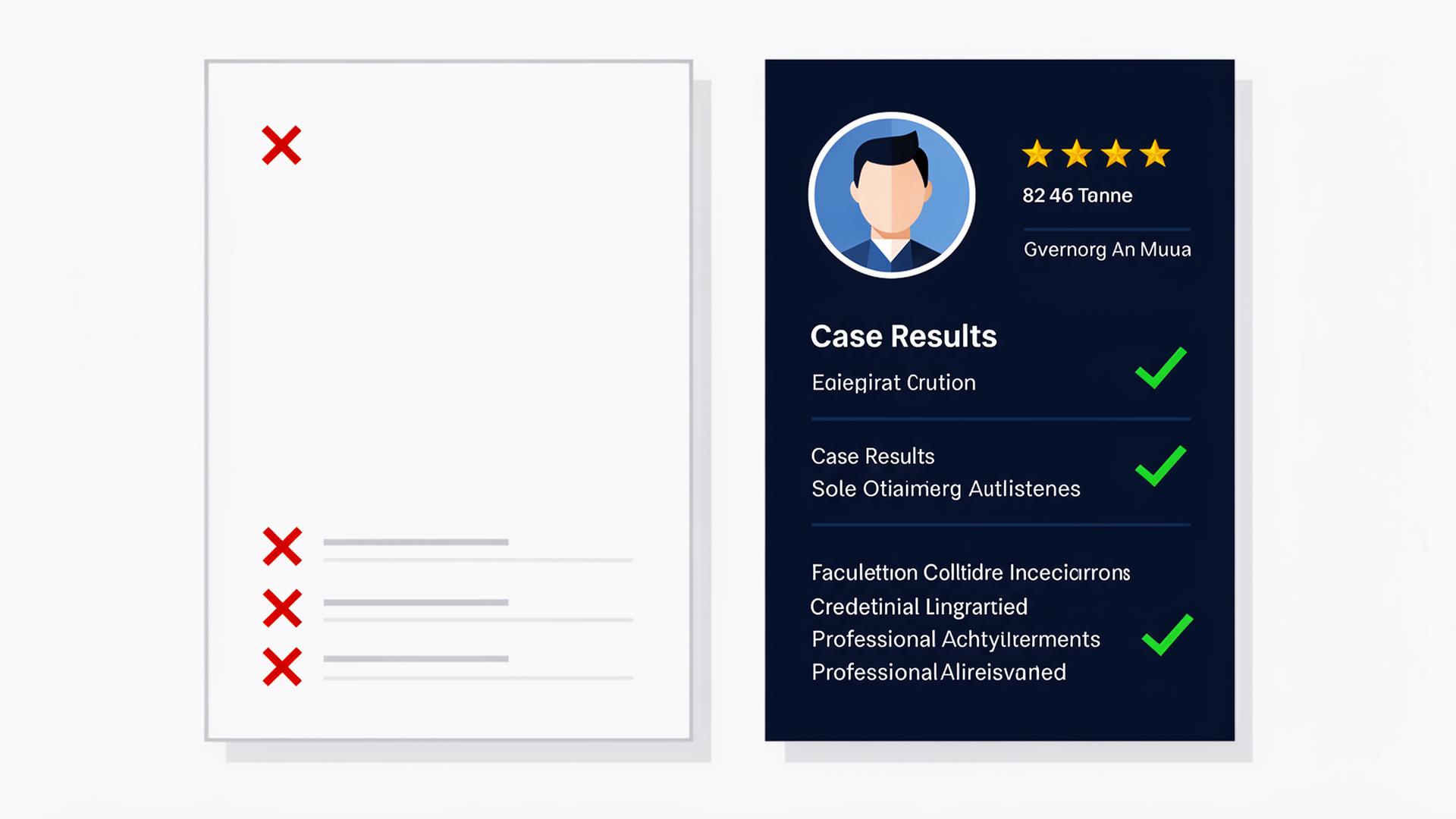
We audit law firm websites regularly as part of our onboarding process, and the pattern is remarkably consistent. Most attorney bios include: the attorney's name and title, their law school, year of bar admission, a list of practice areas in bullet points, maybe one or two professional memberships, and a headshot. That is it.
Here is why this is a problem. Every attorney on page one of Google has a law degree and a bar admission. Those are baseline requirements to practice law. Listing them without additional context is like a doctor listing "graduated from medical school" as their primary credential. It does not differentiate you from anyone.
The other common issue is the generic philosophy statement. "Attorney Smith is dedicated to providing excellent legal representation and fighting for justice on behalf of his clients." This type of language appears on thousands of law firm websites. It tells Google nothing specific about this attorney's expertise, and it tells potential clients nothing that would make them choose this attorney over any other.
Key Insight
"No authority can be built unless you have a strong author profile. We need to find the missing gaps and build an about section that sends the strongest possible signal for authority. When we analyzed who ranks number one for the toughest keywords, their credibility was through the roof. That is what we are building toward for every client."
Artem Saribekyan, CEO & Founder, Doctor Rank
What a Strong Attorney Bio Includes
The law firms that rank at the top of competitive legal keywords have attorney bios that read like a case for authority. Here is what they include that most firms miss:
Specific Case Results (Where Ethically Permitted)
Nothing demonstrates experience like documented outcomes. "Secured a $4.2 million verdict in a medical malpractice case involving surgical error" is infinitely more powerful than "handles medical malpractice cases." If your state bar rules allow it, case results with appropriate disclaimers are among the strongest authority signals available. They prove you have done the work.
Trial Experience with Numbers
"Has tried over 150 cases to verdict" sends a clear signal about depth of experience. Many attorneys list trial experience vaguely, but quantifying it gives Google and potential clients a concrete measure of your expertise. If you have handled thousands of cases in a specific practice area, say so.
Bar Leadership and Professional Involvement
Membership in the state bar association is standard. Serving on a committee, holding a board position, or chairing a section is an authority signal. If you have been appointed to a judicial committee, serve as a mentor for newer attorneys, or hold a leadership role in a specialty bar association, these should be prominently featured.
Publications and Speaking Engagements
Have you published articles in legal journals, been quoted in news publications, or spoken at CLE conferences? These are third-party validation signals that Google values highly. An attorney who is invited to teach other attorneys about a legal topic is, by definition, an authority on that topic.
Awards and Recognitions with Context
Super Lawyers, Best Lawyers in America, Martindale-Hubbell AV rating, and similar recognitions carry weight when you explain what they mean. Instead of just listing "Super Lawyers 2020-2026," explain that Super Lawyers is a peer-reviewed selection process that recognizes the top 5% of attorneys in each state based on professional achievement and peer recognition. The context makes the credential meaningful to both Google and potential clients.
Community Involvement and Pro Bono Work
Pro bono work, community legal clinics, and volunteer involvement humanize your profile and demonstrate commitment beyond billable hours. For potential clients, this signals that the attorney cares about their community. For Google, it adds another layer of verifiable activity that supports the attorney's authority.
How Google Evaluates Attorney Expertise by Practice Area
Just as Google evaluates medical expertise topic by topic, it does the same for legal content. If your firm has a personal injury partner and a family law associate, the personal injury attorney should be the authority on your personal injury pages and blogs, while the family law attorney should be featured on family law content. Putting the wrong attorney on the wrong practice area page weakens the E-E-A-T signal, the same way a head and neck surgeon on a liposuction page weakens medical authority. We covered this concept in our article on how provider credentials affect procedure pages.
The Client Conversion Side of Attorney Bios
Rankings are only half the equation. Your bio page is also a conversion tool. When a potential client finds your firm through Google and clicks to your attorney profile, they are deciding whether to contact you. A comprehensive bio that demonstrates real experience, specific results, and genuine expertise gives them confidence. A thin bio that reads like everyone else's gives them no reason to stay.
We have seen this pattern repeatedly across the law firms we manage. When we rebuild attorney bios with comprehensive credentials, specific case results, and detailed expertise sections, the practice area pages those attorneys are linked to see increases in rankings, contact form submissions, and phone calls. The authority that helps you rank also helps you convert.
How Your Attorney Bio Affects AI Search Recommendations
When someone asks ChatGPT or Perplexity "who is the best personal injury lawyer in [city]," AI platforms scan for structured evidence of expertise. A comprehensive attorney bio with verifiable credentials, case results, and professional achievements gives AI platforms the data they need to confidently recommend your firm. A generic bio gives them nothing to work with. We help law firms optimize for both traditional search and AI search visibility.
How Doctor Rank Rebuilds Attorney Profiles
We audit and rebuild attorney profiles as part of our SEO services for personal injury lawyers, family law attorneys, and criminal defense lawyers. We research each attorney's credentials, case history, publications, and professional involvement, then structure the bio to send the strongest possible authority signals to Google and AI platforms. Contact us for a free assessment.
Frequently Asked Questions
How long should an attorney bio page be?
The top-ranking attorney profiles we have analyzed typically run 600 to 1,200 words. Length should be driven by substance. An attorney with 25 years of experience, hundreds of cases, and significant professional involvement will naturally have a longer profile. The key is to include everything that demonstrates genuine authority without padding with filler.
Should every attorney at our firm have their own bio page?
Yes. Every attorney whose name appears on practice area pages or blog content should have a dedicated, detailed bio page. This creates a direct link between the content and the credentialed professional behind it, which is exactly what Google's E-E-A-T framework evaluates.
Can we include case results if our state has advertising restrictions?
This varies by jurisdiction. Many states allow attorneys to reference case results with appropriate disclaimers such as "past results do not guarantee future outcomes" and "each case is unique." Check your state bar's advertising rules or consult with your ethics counsel. Where permitted, case results are one of the most powerful authority signals you can include.
References and Sources
- Creating Helpful, Reliable, People-First Content (E-E-A-T) - Google Search Central Documentation
- Google Search Quality Rater Guidelines - Google (PDF)
- February 2026 Discover Core Update - Google Search Central Blog
Published by Doctor Rank. Strategies discussed in this article are based on our direct experience managing SEO for 40+ healthcare and legal practices. Google's algorithms evolve continuously, and what works today may shift with future updates. For a personalized assessment of how these changes affect your practice, contact our team.
Written by
Artem Saribekyan
Artem is the CEO and founder of Doctor Rank, a digital marketing agency specializing in local SEO and AI search optimization for healthcare providers and legal professionals. Based in New York, Doctor Rank manages SEO for over 20 accounts including personal injury attorneys, family lawyers, criminal defense attorneys, plastic surgeons, dermatologists, and dental practices.
Learn more about our team