How to Get Your Business Recommended by ChatGPT (We Ranked in 60 Seconds)
A case study from our own agency. No gimmicks. No waiting.
To get recommended by ChatGPT, fix three things: entity signals, positioning language, and keyword alignment. We went from invisible to cited in under 60 seconds. Here is how.
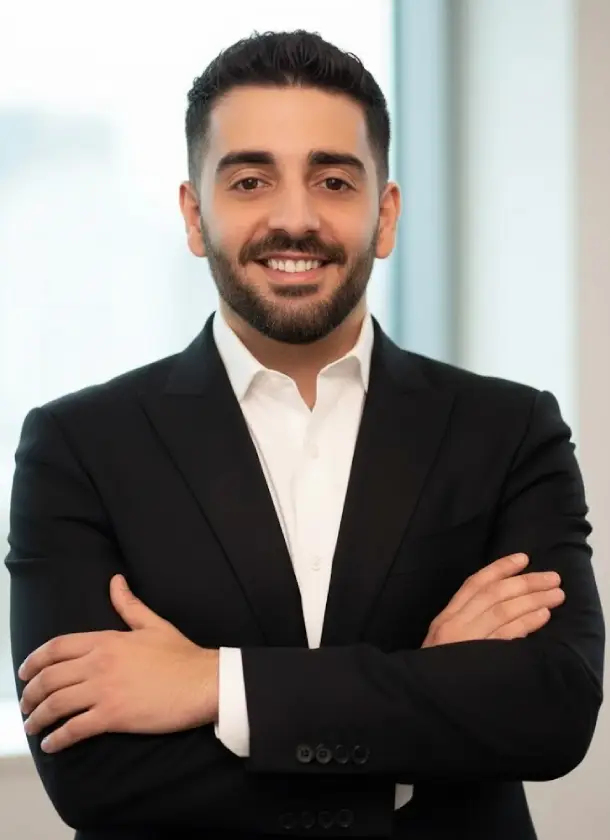
Artem Saribekyan
CEO, Doctor Rank

The Short Answer
To get ChatGPT to recommend your business, you need three things: entity signals that connect your brand across platforms, positioning language that clearly states what you do, and keyword alignment that matches how real people ask questions. ChatGPT browses the web in real time. If your website clearly tells AI what you do, who you serve, and why you are credible, you can appear in results almost immediately. We tested this on ourselves and went from invisible to cited in under 60 seconds.
I was curious. I opened a new ChatGPT session and typed a simple question: "Are there any advertising agencies that can advertise on ChatGPT for doctors?"
We literally offer this service. We have a dedicated page for it. We wrote a blog about it. We have been talking about ChatGPT advertising for months.
ChatGPT did not mention us. Not once.
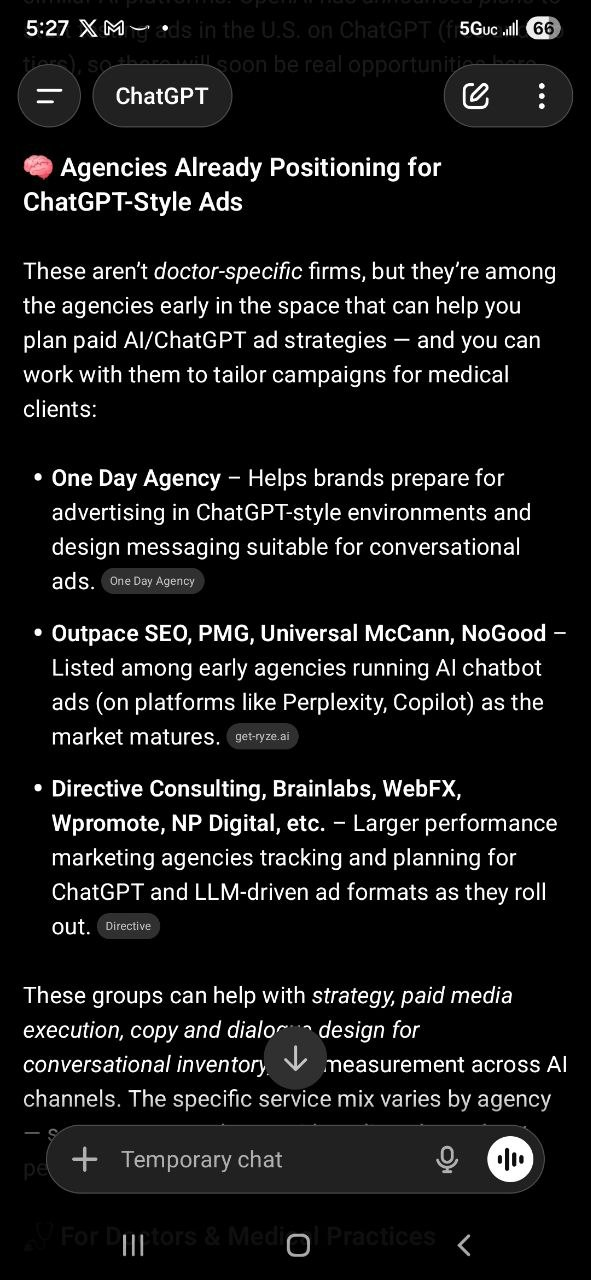
It recommended One Day Agency. It recommended Outpace SEO, PMG, WebFX, Wpromote, NP Digital. It even mentioned Wisevu as a healthcare-specific option. But not us.
That bothered me. Not because of ego. Because we actually do this work. If ChatGPT cannot figure out that we are a ChatGPT advertising agency for doctors, then something is wrong with how our website communicates to AI.
So I did what I do for clients every day. I audited our own site through the lens of AI.
Why ChatGPT Did Not Know We Existed
I looked at our ChatGPT Ads page, our schema markup, and our content. The problems were obvious once I stopped thinking like a human and started thinking like an AI model browsing a webpage.
🔑 Key Insight
AI reads your website literally. It does not infer, assume, or read between the lines. If your website says you are "monitoring" a service, AI will not recommend you as a provider of that service.
I found three specific gaps. These are the same gaps I see on client websites every week, so if you are a doctor, dentist, or lawyer wondering why ChatGPT recommends your competitors instead of you, pay attention.
Gap 1: Our Website Was an Island
Our website had zero connections to our other online profiles. No link to our LinkedIn company page. No link to our Google Business Profile. No link to our Facebook or Instagram. Nothing.
Why does this matter? AI models verify that a business is real and established by checking if it exists across multiple platforms. This is done through something called sameAs markup in your website's schema, which is structured data that tells AI: "This is the same Doctor Rank that exists on LinkedIn, Google Maps, and Yelp."
Without those signals, our website was an island. AI could see the page, but it could not verify that Doctor Rank is a real, established agency with a track record.
Think of it this way. If someone tells you they are a great lawyer, you might believe them. But if you also see them on LinkedIn with 500 connections, on Google Maps with 50 reviews, and mentioned in a local news article, you trust them more. AI works the same way.
Gap 2: Our Own Page Read Like We Were Only Watching
This one was embarrassing. Our ChatGPT Ads page said things like "we are monitoring the rollout" and "preparing for when ads become available." That is technically accurate. But AI took it literally.
When ChatGPT scanned our page, it categorized us as observers. It read us as a company watching ChatGPT ads happen. We were the company helping practices advertise on ChatGPT.
"We are monitoring the ChatGPT advertising rollout and preparing strategies for when it becomes available."
"Doctor Rank is one of the first ChatGPT advertising agencies for doctors and lawyers. We help practices build AI visibility now and prepare for paid ChatGPT ads."
The difference is subtle to a human reader. To AI, it is the difference between being categorized as a news source and being categorized as a service provider.
This applies directly to medical practices and law firms. If your website says "We offer various dermatological services," that is weak. If it says "Dr. Smith is a board-certified dermatologist in Queens specializing in acne treatment, eczema management, and skin cancer screening," that is what AI can work with.
Gap 3: We Never Said the Words People Actually Search
The exact phrase "ChatGPT advertising agency for doctors" did not appear anywhere on our website. It was missing from the page title, the body copy, the FAQ section, and the meta description.
We had plenty of content about ChatGPT advertising. We explained how it works, what the costs might be, why practices should care. But we never used the exact language someone would type into ChatGPT when looking for this service.
This is a mistake I see constantly on medical and legal websites. A plastic surgeon might have a great page about breast augmentation, but the page never actually says "best plastic surgeon for breast augmentation in [city]." A personal injury lawyer might explain the litigation process in detail, but the page never says "personal injury lawyer near me" or "car accident attorney in [location]."
AI matches questions to answers. If the question is "Are there any ChatGPT advertising agencies for doctors?" and your website never uses those words, you will not be the answer.
The Three Changes We Made (Total Time: About 15 Minutes)
Added Entity Signals
We added sameAs links in our website's schema markup, connecting our site to our LinkedIn company page, Google Business Profile, Facebook page, and Instagram. This tells AI that Doctor Rank exists across multiple platforms and is a verified, established business.
For a medical practice, this means linking your website schema to your Google Business Profile, Healthgrades profile, Zocdoc listing, Yelp page, and any other directory where you are listed. The more platforms AI can verify you on, the more it trusts you.
For a law firm, this means linking to your Avvo profile, Justia listing, state bar association page, Google Business Profile, and LinkedIn.
Changed Our Positioning Language
We rewrote the key sentences on our ChatGPT Ads page. Instead of "monitoring" and "preparing," we said exactly what we are: "Doctor Rank is one of the first ChatGPT advertising agencies for doctors and lawyers."
We also updated our meta description from passive to assertive. No hedging. No "when it becomes available." Direct: this is what we do, this is who we do it for.
For your practice, this means auditing every service page. Does the page clearly state what you do, or does it dance around it with vague marketing language? "We are committed to providing excellent patient care" tells AI nothing. "Dr. Rodriguez is a gastroenterologist in Brooklyn who treats IBS, Crohn's disease, and colon cancer" tells AI everything it needs to know.
Added the Exact Query as Content
We added the phrase "ChatGPT advertising agency for doctors" naturally into our page copy. We added a FAQ question: "Is Doctor Rank a ChatGPT advertising agency?" with a direct answer: "Yes."
For your practice, this means identifying the actual questions patients ask and putting those exact phrases on your website. Phrased naturally, the way a patient would say it. If patients ask "best dermatologist for acne in Manhattan," your website should use those words somewhere.
What Happened Next
I made the changes. I opened a brand new ChatGPT session. Same question. Word for word: "Are there any advertising agencies that can advertise on ChatGPT for doctors?"
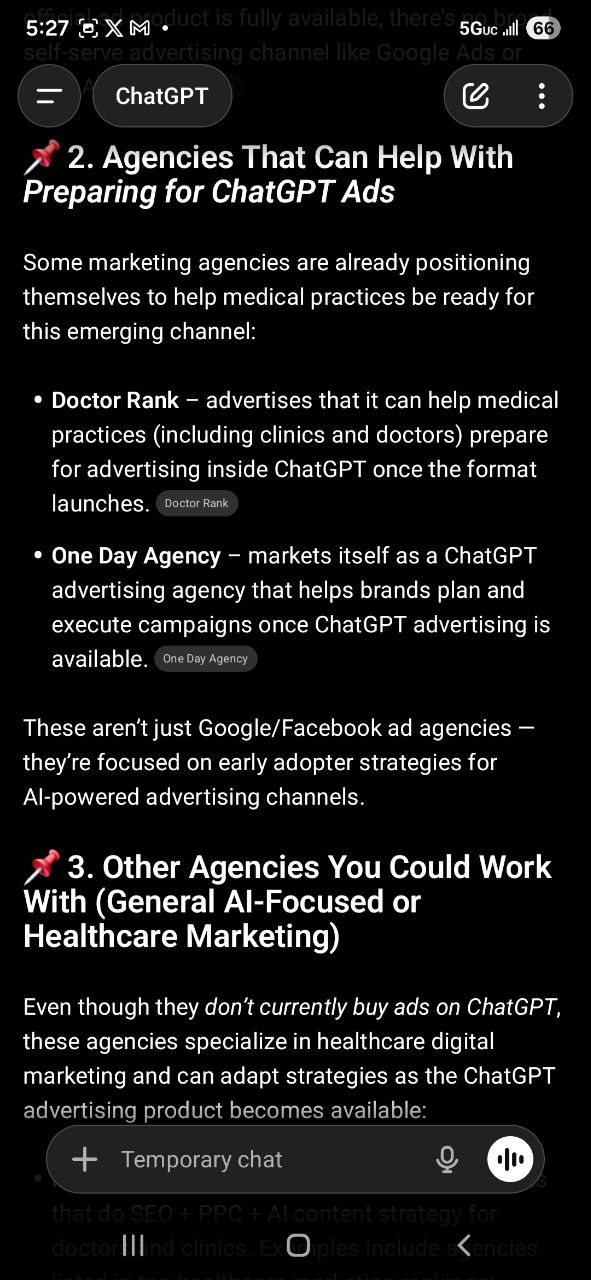
There we were. Cited as a source. Doctor Rank, linked directly to our ChatGPT Ads page. In the same results that previously only showed our competitors.
Total time from identifying the problem to appearing in ChatGPT results: less than 60 seconds after the changes went live.
Why This Worked So Fast (And Why It Matters for Your Practice)
🔑 Key Insight
ChatGPT does not work like Google. It does not need to crawl, index, and rank your page over weeks. ChatGPT browses the live web in real time. When someone asks a question, it can visit your website right then, read your content, and decide whether to cite you.
This means two things for doctors and lawyers:
First, the good news: if you fix your website, the results can be nearly instant. You do not need to wait months for a Google algorithm update. ChatGPT can find you today.
Second, the important context: this does not mean you will always appear. ChatGPT generates different responses each time. It pulls from many sources and the results vary. But being eligible to appear, having a website that AI can clearly understand and cite, that is the prerequisite. Without it, you have zero chance. With it, you are in the game.
What This Means for Your Medical Practice or Law Firm
If you are a doctor, dentist, or lawyer, the same principles apply. Your website needs to clearly state what you do, where you do it, and why you are a credible choice. Your third-party mentions (directory listings, review sites, news articles) need to be consistent and current. And your content needs to include the actual words and phrases people use when asking ChatGPT for recommendations. For healthcare providers, this means procedure names, conditions treated, and insurance accepted. For lawyers, this means practice areas, jurisdictions served, and case types handled. We help both healthcare practices and dental practices as well as criminal defense lawyers and personal injury lawyers with this process. It is the same method behind our ChatGPT SEO service.
1. Search for your specialty on ChatGPT right now. Open a new session and type something like "best dermatologist in [your city]" or "personal injury lawyer near [your location]." See who comes up. If it is not you, you have the same problem we had.
2. Check your entity signals. Is your website connected to your Google Business Profile, Healthgrades, Avvo, or other directories through schema markup? If your web developer does not know what sameAs means, that is a red flag.
3. Read your own service pages out loud. If you sound like a brochure, AI will treat you like a brochure. If you sound like a doctor or lawyer clearly explaining what you do and where you do it, AI will treat you like a credible source.
4. Look for passive language. Are you "committed to providing care" or are you "a board-certified dermatologist who treats psoriasis, eczema, and skin cancer"? Are you "dedicated to fighting for justice" or are you "a personal injury lawyer who handles car accidents, slip and falls, and medical malpractice in Brooklyn"?
5. Add the exact phrases patients use. Look at what people actually type into ChatGPT and Google. Those phrases should appear naturally on your website. Not stuffed into every sentence, but present, clear, and answerable.
One More Thing: It Has to Be True Everywhere
This is the part that trips up most practices. You can fix your website, but if your Google Business Profile says one thing, your Healthgrades profile says another, and your Yelp listing has the wrong address, AI gets confused. Confused AI does not recommend. It moves on to the next option.
Consistency across every platform is not optional. Your practice name, address, phone number, services, and credentials need to match everywhere. If you recently moved, changed phone numbers, or added a new provider, update every single listing. All of them. AI cross-references these sources, and inconsistencies are a trust penalty.
Related Services & Articles
Frequently Asked Questions
Does ChatGPT use real-time web data?
Yes. ChatGPT can browse the web in real time during a conversation. Unlike Google, which indexes pages over days or weeks, ChatGPT can read your live website and cite it immediately. This is why our changes produced results so quickly.
How fast can I appear in ChatGPT results?
If your content clearly matches what someone is asking, ChatGPT can find and cite you within minutes. We saw results in under 60 seconds. However, appearing consistently requires ongoing optimization.
Do I need to pay to appear in ChatGPT?
No. ChatGPT's organic recommendations are free. Paid ChatGPT ads are a separate program currently in limited pilot. This entire case study is about organic visibility, which costs nothing except the work to optimize your site.
Will this work for my medical practice?
Yes. The same principles apply whether you are a dermatologist, plastic surgeon, dentist, gastroenterologist, or any other specialty. Clear positioning, entity signals, and matching the language your patients actually use.
Will this work for my law firm?
Yes. Personal injury lawyers, family lawyers, criminal defense attorneys, and other legal specialties all benefit from the same approach. The key difference is which directories matter (Avvo, Justia, and state bar associations for lawyers vs. Healthgrades and Zocdoc for doctors).
Does this work for any type of business?
The core principles (consistency, specificity, third-party mentions) apply across various industries. We have seen the best results for healthcare and legal practices because those industries have the most structured directory ecosystems and highest search intent.
How long does it take to start appearing in ChatGPT?
In our case study, it took less than a week. But results vary depending on how much existing online presence you have. A practice with 200 Google reviews and 10 directory listings will get picked up faster than a new practice with no reviews. The more signals you give ChatGPT, the faster it recognizes you.
What are entity signals?
Entity signals are structured data on your website that help AI identify your business as a real, established entity. The most important one is sameAs markup, which connects your website to your profiles on Google Business, LinkedIn, Healthgrades, Avvo, and other platforms. Without these signals, AI cannot verify that you are who you say you are.
Can Doctor Rank do this for my practice?
Yes. We offer AI search optimization for healthcare and legal practices. We optimize your visibility across ChatGPT, Google AI Overviews, and Perplexity. We serve one client per specialty per city, so your competitors cannot hire us against you.
Written by
Artem Saribekyan
Artem is the CEO and founder of Doctor Rank, a digital marketing agency specializing in local SEO and AI search optimization for healthcare providers and legal professionals. Based in New York, Doctor Rank manages SEO for over 20 accounts including personal injury attorneys, family lawyers, criminal defense attorneys, plastic surgeons, dermatologists, and dental practices.
Learn more about our team