How Long Does SEO Take to Bring in New Patients for a Dental Clinic?
The honest timeline, and the question you are really asking underneath it.
The honest answer for dentists: with a website rewritten in your patients' language, new appointment requests can start inside 30 days. Here is the real timeline.

Artem Saribekyan
CEO, Doctor Rank

The Short Answer
If your dental website gets rewritten in your patients' language and Google recrawls it, you can start seeing new appointment requests inside the first 30 days, sometimes within a week of it being indexed. The old "give it six months" rule is dead for dentists. Below is the honest timeline, and the question you are actually asking underneath this one.
What You Are Really Asking: "How Long Do I Have to Pay Before This Works?"
Every dentist asks how long SEO takes for the same reason. You are paying an agency up front, every month, before you have seen a single new patient from it. So the real question is not "how long does SEO take." It is "how long do I have to keep paying this agency before the phone actually rings?"
That is a fair question, and you deserve a straight answer instead of a shrug. Be careful with anyone who tells you "one month," "three months," "six months," or the classic dodge, "it depends." What it depends on is what they actually do to your website. If the work is real, the timeline is short. If the work is a template, you can pay for a year and feel nothing.
The Honest Timeline: When a Dental Practice Sees Its First New Patients
Here is the method that actually works, and it has zero tricks in it. No black hat, no link schemes, nothing that puts your practice at risk. It is all about the words on your website: your homepage, your dental implant page, your veneers page, your sedation page. Are those pages written in your patient's language, or are they written for a search engine?
Think about the actual human deciding whether to book you. Before they ever walk in, they want to see what your office looks like, so you need real photos. They want to know your credentials. They want you to walk them through the procedure, step by step, and answer the exact worry in their head before they pick up the phone. That is the same information they now type into ChatGPT. A page that answers all of it wins. A page optimized for "best dentist near me" does not.
When your site is genuinely personalized like that, it already looks different from 99% of the dental clinics in your area. Once Google recrawls it, which takes anywhere from 24 hours to two weeks, you start showing up as a real choice.
At Doctor Rank we rewrite the full website in your own voice, personalized to your patients, answering their real concerns, because we interview you instead of guessing. For a 20 to 30 page site, that is about two weeks of writing and the site is republished by week three. After the first 30 days, you are already seeing calls and appointment requests you were not getting before.
Why Dental SEO Is Faster in 2026 Than the Old Six-Month Rule
The six-month rule came from an older internet. Back then you needed a pile of backlinks and a domain authority score high enough for Google to trust you, because Google genuinely did not know who you were.
That is not your situation as a dentist. Google already knows you. You are board certified, your name is on directories, you are listed as a provider somewhere, your practice has a footprint online. The name is recognizable. So there is no reason for Google to sit on you for six months to decide if you are legitimate. That part is already settled. What is left is what is actually on your website.
Here is the catch. Your site can say "best dentist in Miami," but so does everyone else's. When every headline uses the word "best," the word means nothing and it ranks nothing. The move is the opposite: read your own Google reviews, look at what your patients actually say about you, and reverse-engineer your website content around those real words. That is what Doctor Rank is good at, and it is why our sites speak to the patient. Google and the AI models reward you for focusing on the end user, and they will not put a risky, keyword-stuffed site in front of someone. Once your site is updated and Google crawls the new content, usually within the first seven days, it starts pulling patients. Under 30 days is normal. It is close to instant now.
What Actually Counts as a Result: Rankings vs Phone Calls vs Booked Patients
Rankings are not the scoreboard people think they are. You can sit in the map pack (the top three) and still get squeezed, because there is so much paid real estate stacked above you. That is exactly why more people now go straight to AI search, Gemini on Google or ChatGPT, where if there is an ad at all it is a single one at the bottom. It is a fairer fight.
Google also quietly made it harder even when you do rank. Your phone number no longer shows at first glance on your Business Profile. Someone has to click into the profile before the number appears, and every extra click loses people. So ranking still matters, there are just more obstacles in front of it than there used to be. AI search skips all of that and simply presents you as the answer.
The real results, in order, are: your impressions climb, then inquiries trickle in, then those inquiries compound into booked patients.
What Happens in Your First 90 Days
After the first month, once the site content is rewritten and actually personal to the patient, someone finds your veneers page for the first time, sees the process, gets a sense of the cost, and reaches out. Little inquiries at first. Then they compound and people start booking.
One honest warning: if 10 people call, that does not mean 10 patients walk in. Someone will not like how your front desk answered. Someone calls when the line is busy. Someone never gets through at all. That leak is why we recommend pairing this with our voice AI, so a real-sounding assistant catches the calls your front desk misses. The SEO fills the top of the funnel; do not let a missed phone call empty it out.
How AI Shortens the Time to Get New Patients
AI cuts straight through the SEO noise. The models can tell whether a page was written for keywords or written for a person. If your dental clinic is still doing the keyword thing, you most likely are not showing up in AI answers at all. If your content genuinely answers the patient, you get named. That is the whole game now, and it is why the timeline collapsed from months to weeks.
Want to know where your practice stands today? Book a free audit and we will show you exactly what an AI sees when a patient asks it for a dentist in your area.
The Early Signs Your Dental SEO Is Working Before the Calls Spike
Before the phone starts ringing, the first place to look is Google Search Console, specifically your impressions. Impressions are the number of times your website showed up in someone's search results. If that line is trending up, that is your earliest signal, forget the clicks for now. Rising impressions mean Google decided your site is valuable and wants to show it more often.
Do not obsess over your ranking position during this window, because you are getting found for a widening set of searches. Search Console also shows the number of keywords you are now appearing for, and that count should be climbing well past what your dental site was found for before. More impressions and more keywords, that is momentum, and it shows up weeks before the calls do.
When to Worry: How to Tell Your Dental SEO Agency Was the Wrong Fit
A lot of dentists come to us after a year or two with a bigger agency, often one with the word "doctor" or "patient" right in its name. So here is how to judge, honestly.
First, the contract. If an agency locks you into a year up front, that is a red flag in 2026. We do not do contracts. We ask for an agreement to give the work a fair window, 60 days in most markets, 90 at the most in a competitive one, before you judge it or walk. And even inside that window the signals above (impressions climbing versus where they were the month before you started) already tell you whether it is working.
Understand what you are paying for. This is not paid advertising. With Meta or Google Ads you are renting the top spot and it vanishes the second you stop paying. We do not run Google Ads, though we do help with Facebook and Instagram ads when they fit. SEO is different: give it roughly 30 to 45 days to see the impression uptrend, and give the phone-calls-and-revenue side a little longer to catch up. For context, dental retainers usually run anywhere from $800 to $2,500 a month. Ours sits right in the middle.
Now, why the year-long contract is dangerous. The real work here is heavy: we ask around 10 questions per treatment, then write, publish, and rewrite the entire site around your real answers. A shop managing thousands of dental accounts cannot do that for everyone, it is not feasible. So they template it. Bare minimum, generic, written by AI on top of content that already exists a thousand times over, never actually personalized. That is the AI slop you already see everywhere, and Google can and does punish sites for it. So a year lock-in goes past wasted money. It can actively hurt you.
And do not be fooled by a big name and a wall of good reviews. That reputation was earned years ago when SEO was easy. It is not easy now. Picture running an agency with thousands of clients: the attention that used to sustain results no longer does, and now every account needs five times more of it. Do they raise prices? No. Hire more people? No, the margins are too thin. So they do the same thin work, promise and promise, and lock you in for a year. I hear this exact story on nearly every call.
The worst part is the exit. Plenty of dentists wanted to switch to us and could not, because they were still on the hook to the old agency for months. Some switched anyway and had to pay a cancellation fee, and then found out the website itself did not belong to them under the contract, so they either waited it out or paid off the full remaining build cost, which was a ridiculous number. One clinic had to ride out six months to fulfill their agreement, and nothing changed for them the entire time. The week they moved to us, the traffic started climbing.
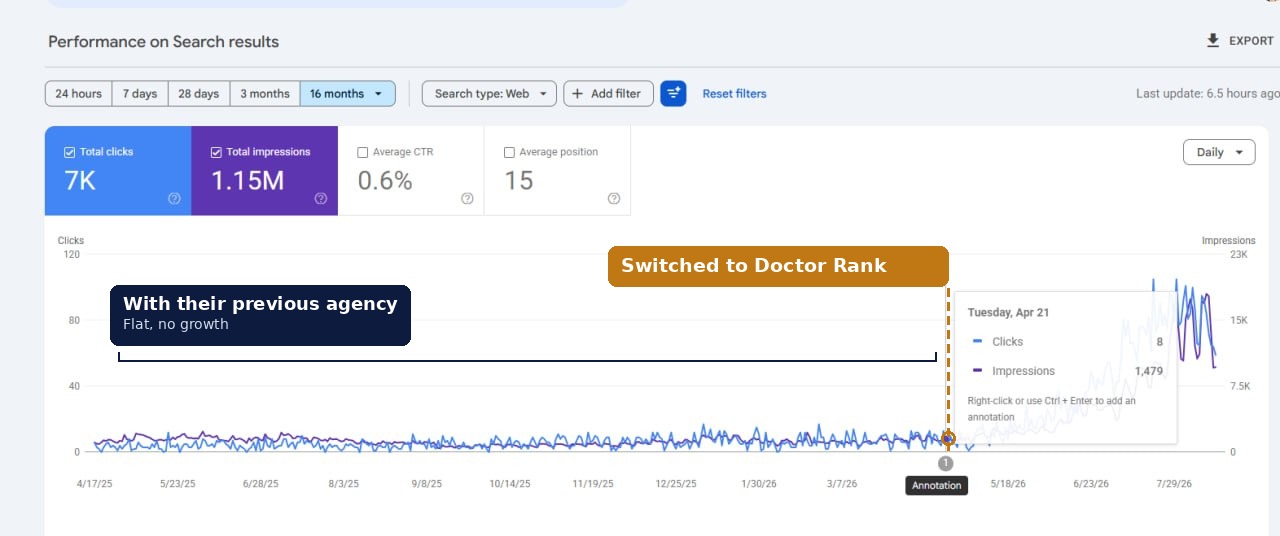
For what it is worth, it is always smart to talk to a couple of agencies before you commit, just so you can hear the difference for yourself.
We have never charged a penalty to leave, and we never have to. Our retention is 100%: the clients who signed on years ago are still with us, because they survived every algorithm update and kept making money. Happy clients do not need a contract to stay.
Common Questions
Do I own my website when I work with you?+
Yes. The site, the content, and the domain are yours. There is no penalty to leave and nobody holds your website hostage if you do. If an agency will not put that in writing, that is your answer about them.
What do I actually have to do on my end?+
Answer questions. We interview you, roughly 10 per treatment, so the content sounds like you. We handle the writing, the publishing, and the rewrites. Your time goes into the interview only.
Does this still work if I am in a competitive city?+
Yes, it just takes a little longer to read the trend, closer to 90 days than 60. A crowded market is exactly where a personalized, patient-first site pulls away from the keyword-stuffed ones around it.
If my content is good, do reviews even matter anymore?+
They matter more, because they are the raw material. We read what your patients actually said and build your pages around those real words. Good content and real reviews are the same play.
Written by
Artem Saribekyan
Artem is the CEO and founder of Doctor Rank, a digital marketing agency specializing in local SEO and AI search optimization for healthcare providers and legal professionals. Based in New York, Doctor Rank manages SEO for over 20 accounts including personal injury attorneys, family lawyers, criminal defense attorneys, plastic surgeons, dermatologists, and dental practices.
Learn more about our team